Password reset email sent. Please check your email inbox or spam folders. If you have not received an email, please get in contact with us.
Password reset success. Click here to Login.

In the world of finance and procurement, automation is no longer a “nice-to-have”, it’s becoming essential. But as companies explore their digital transformation journey, they often encounter two terms that sound similar but mean different things: AP Automation and P2P Automation. Here at Pegasus, you may know that we recently gave our AP Automation solution an upgrade to full procure-to-pay (P2P) Automation. But what’s the difference?
While both aim to streamline processes, reduce manual effort, and improve visibility, they address different scopes within the financial operations cycle.
Accounts Payable (AP) Automation focuses specifically on the invoice-to-payment process. It’s about making sure vendors get paid accurately and on time, without the headaches of paper invoices, manual data entry, and error-prone approvals.
AP Automation can:
By automating AP, businesses can cut processing costs, avoid late fees, and even capture early payment discounts.
Procure-to-Pay (P2P) Automation covers the entire end-to-end process from the moment an employee identifies a need to the final payment to the supplier.
It integrates procurement and accounts payable into one seamless workflow. Did you know a staggering 20% of procurement spend can be wasted due to inefficient workflows? P2P covers:
In other words, P2P Automation doesn’t just handle invoices it ensures the entire purchasing and payment cycle is standardised, compliant, and transparent and can reduce processing times from 12-15 days down to as little as 3.
With P2P, businesses gain oversight into spend before it happens, not just after an invoice arrives, giving complete cash flow visibility, improving visibility into spend management by 40-60%.
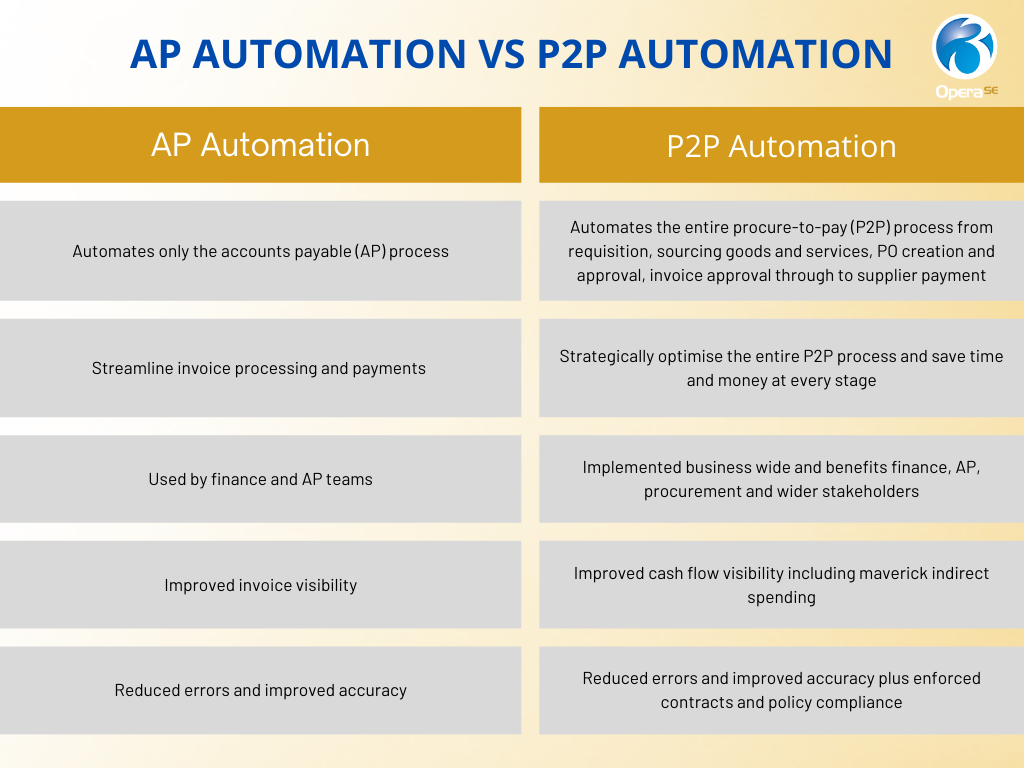
If you want end-to-end control over spend, from purchase requests to payments, P2P Automation delivers every time and sees productivity gains of over 28%. AP Automation is a key component of P2P Automation but P2P goes further, connecting procurement and finance into a unified ecosystem and can reduce procurement processing costs by over 30%.
AP Automation solves for efficiency in accounts payable, while P2P Automation drives efficiency and control across the entire procure-to-pay cycle.
Is it time to discover Opera 3 SE P2P Automation? Take a look and contact us to see it in action.
Posted On: September 11, 2025